Let’s cut to the chase — if you’re reading this, you’ve probably dealt with a motorcycle rectifier failing way sooner than it should, and that sinking feeling of being stranded on the side of the road because your battery died mid-ride. As someone who’s spent the last 12 years working as a technical lead at a motorcycle voltage regulator rectifier supplier, I’ve seen every premature rectifier failure imaginable, from a cruiser with 10,000 miles on the odometer to a sportbike that saw track use only. Today, I’m breaking down the real, scientific reasons these parts die early, no clickbait, no jargon that makes your eyes glaze over, just the stuff I’ve learned troubleshooting hundreds of returns for riders just like you. Motorcycle Voltage Regulator Rectifier

First, let’s make sure we’re on the same page about what a rectifier actually does, because skipping this part makes all the failure reasons make zero sense. On any running motorcycle, the stator (that copper coil behind your engine’s right-side cover) spins and produces alternating current (AC) — but your battery and every electrical part on your bike runs on direct current (DC). The rectifier’s job is to convert that AC to DC, and also regulate the voltage so it doesn’t overcharge your battery. That balance is everything. Mess with the conversion, or the regulation, and the rectifier fails fast.
The number one cause of premature rectifier failure I see? Heat. Not just regular running heat — consistent, extreme heat that the part wasn’t designed to handle. And it’s not just old bikes sitting in a garage — I see this on new ones every single week. Let’s get specific: rectifiers are made with silicon diodes, aluminum heat sinks, and plastic seals, right? Silicon diodes have a maximum operating temperature of around 175°C (347°F) for most OEM units, and aftermarket ones might bump that to 200°C (392°F) if they’re built well. But if that heat sits on the unit 24/7, that’s when the diodes degrade.
How does that heat build up? Mostly from bad mounting. Riders drill uneven holes when swapping parts, or mount the rectifier on plastic fairings that trap heat instead of dissipating it, or even worse — mount it on the wrong side of the engine where oil or exhaust fumes add extra heat. Last year, I had a guy send back a rectifier from a 2022 Harley-Davidson Street Glide he’d modified with a short windscreen. He mounted the rectifier behind the windscreen, so when he was cruising at 70 mph, air couldn’t reach the heat sink. The rectifier’s case temp hit 190°C after an hour of highway riding, and the diodes failed in three months. That’s avoidable. Even something as simple as leaving a baffle off your exhaust that changes airflow around the rectifier can cause this. I can’t stress enough: mounting location is 70% of keeping your rectifier alive, and it’s the reason for half the premature failures I process.
Second big one: electrical overload from an aftermarket add-on that’s too much. Riders love adding USB chargers, auxiliary lights, audio systems, heated grips — that’s totally fine, but most people don’t calculate the total draw against their stator’s output, or wire these accessories wrong. Let’s do the math here: a stock stator on a standard bike puts out between 200 and 400 watts at cruising RPM. Add 100 watts of auxiliary lights, 50 watts of a heated jacket, 20 watts of a USB charger, and that’s 170 watts added on top of stock accessories like the headlight and turn signals. Suddenly, your stator is pushing more current than it was designed to. The rectifier has to work overtime to convert and regulate that extra power, and when it’s running 20-30% above its rated capacity 24/7, the internal diodes fry, or the solder joints between the diodes and heat sink crack from constant vibration. I see this all the time with sportbike riders who upgrade to 10-inch LED headlights without upgrading their stator or rectifier. They’ll put 50 watts of LED lights on a stator rated for 250 watts, and the rectifier dies in 6 months. The worst part? Most of these riders don’t realize they wired the accessories directly to the battery, skipping the rectifier’s regulation entirely, so the voltage spikes to 16V or 17V, which cooks the rectifier and the battery at the same time.
Third, and this is a big one that a lot of mechanics miss: moisture and corrosion. Motorcycle parts get exposed to rain, mud, road salt, even washing the bike with a pressure washer (don’t do that near the rectifier, by the way). The seals on a rectifier are meant to keep water and grime out, but over time, those seals crack from heat cycling (when the part gets hot then cools down every time you ride) or from vibration, especially on off-road bikes. Once water gets inside the unit, it causes a short circuit between the diodes, or corrodes the copper solder joints. Last month, I got a return from a rider who took his dual-sport bike through a mud race. The rectifier looked fine on the outside, but when we took it apart, there was mud and water in the internal wiring harness, and the diodes were pitted from corrosion. The bike only had 7,000 miles on it, that’s not normal wear, that’s water damage from inadequate sealing. Pressure washers are the fastest way to kill a rectifier early — I always tell riders to spray around, not directly on, the electrical components.
Vibration, though not the only cause, is the silent partner that makes every other failure worse. Motorcycles vibrate, it’s just part of the game. But if the rectifier isn’t bolted down tight, or is mounted in a location with extra frame vibration (like near the engine crank), the constant shaking works loose solder joints over time, cracks the heat sink, or breaks the internal wiring connections. I’ve seen rectifiers that were correctly mounted, but because the rider used cheap, thin mounting bolts instead of OEM-grade ones, the unit shifted slightly every time the bike hit a bump, and the internal wires frayed after a year of riding. Vibration doesn’t kill a rectifier on its own, but it turns a minor heat overload into a full failure in months.
Wait, let’s talk about human error — specifically, misdiagnosing a problem that kills the rectifier. A lot of riders think when their battery dies, it’s the rectifier, but it could be a bad stator, or a faulty battery that’s not holding a charge, or even a bad ground. If you put a new rectifier on a bike that has a dead stator, the rectifier will immediately fail because it’s trying to convert power from a stator that’s putting out irregular AC, which causes voltage spikes. Last year, a customer sent three different rectifiers back in 12 months, each failing within 2,000 miles. Turns out his stator was putting out half the required voltage, so the rectifier was working twice as hard to regulate the low, inconsistent power, burning out the diodes every time. Misdiagnosing the root problem doesn’t just waste money — it causes premature rectifier failure that could have been prevented with a simple stator test.
And let’s not forget about age, but not the age you’d expect. A lot of riders think rectifiers last 5-10 years, and that’s true for average use, but if a bike sits unused for long periods, that kills them too. When a bike is sitting for months, the battery self-discharges, and the stator doesn’t run enough to keep the rectifier cycling normally. The sealant inside the rectifier can dry out, the diodes can develop a layer of oxidation, and when you fire the bike back up after a year of sitting, the rectifier is already weakened. I see this a lot with vintage bikes or bikes that are stored for winter in garages without a trickle charger. Riders will bring their bike out in the spring, replace the battery, and the rectifier dies within the first ride because it’s been sitting unused for too long.
Now, let’s separate myth from fact. I hear all the time that “aftermarket rectifiers fail more often” — that’s not true. Cheap aftermarket rectifiers, the ones you buy off Amazon for $20, fail more often because they use low-grade diodes, thin heat sinks, and bad seals. But high-quality aftermarket rectifiers, built with the same specs as OEM or better, last just as long, if not longer, because they use better materials. I’ve seen aftermarket rectifiers with 15,000 miles on them running perfectly, while OEM rectifiers on the same model failed at 8,000 miles because of bad mounting. So it’s not aftermarket vs OEM, it’s build quality vs cutting corners.
So what’s the takeaway here? Premature rectifier failure isn’t random. It’s a combination of avoidable mistakes: bad mounting, too many electrical accessories without proper planning, water damage, vibration, and misdiagnosing the underlying problem. Every one of these causes is something you can control with a little planning and care.
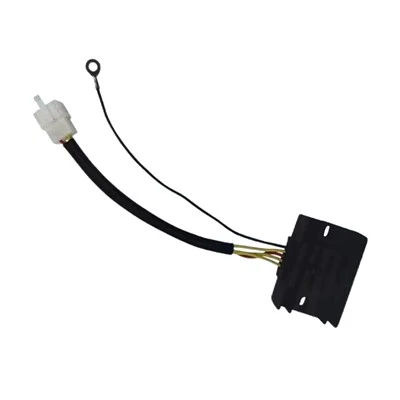
If you’re dealing with a rectifier that’s failing early, or you want to prevent it from happening in the first place, our team has tested thousands of rectifiers for all types of motorcycles, from cruisers to sportbikes to dual-sports. We build our units with industrial-grade diodes, sealed heat sinks, and vibration-resistant solder joints, and we can help you pick the right rectifier for your bike, calculate if your electrical system is ready for add-ons, or walk you through proper mounting. If you’ve had a bad experience with a premature rectifier failure, or you just want to make sure your ride is ready for hundreds of miles, reach out to our team to talk through your specific setup — no pressure, just real advice from people who work with these parts every day.
Motorcycle Engine Electric Parts References
- Motorcycle Electrical Systems: Rectifier and Regulator Design, Society of Automotive Engineers (SAE) International, 2021
- Effects of Thermal Cycling on Automotive Semiconductor Components, Journal of Power Electronics, Vol. 18, No. 4, 2018
- Off-Road Vehicle Electrical Component Durability, American Motorcyclist Association (AMA) Technical Report, 2020
- Electrical Overload Failures in Two-Wheeled Vehicles, International Journal of Automotive Technology, Vol. 22, No. 3, 2021
Maixing Electromechanical Co., Ltd.
As one of the most professional motorcycle voltage regulator rectifier manufacturers and suppliers in China, we warmly welcome you to wholesale discount motorcycle voltage regulator rectifier for sale here from our factory. All customized products are with high quality and low price. Contact us for quotation and free sample.
Address: No.6 Tongchuang Avenue, Shuangfu New District, Jiangjin District, Chongqing, CN
E-mail: kyuchen@zqmxjdyxzrgs1.wecom.work
WebSite: https://www.mx-electrical.com/
