When I first started out as a supplier of head foot operated HF welding machines, one question popped up more often than any other: Can this equipment work on rubber? Early on, I didn’t have a great answer for this — I’d heard vague stories about HF technology and rubber, but nothing concrete from someone who’d fielded this exact question a hundred times, from small fabricators up to large packaging operations. That’s why I spent months testing different rubber grades on our machines, talking to manufacturers, and digging through industry data to get to the bottom of it. Now I can say with confidence that yes, head foot operated HF welding machines can weld rubber — but there are critical details about rubber composition, machine settings, and preparation that make all the difference between a weak, useless weld and one that holds up to years of use. Head Foot Operated HF Welding Machine

Let’s start with the basics, because I know a lot of folks asking this aren’t experts in electromagnetic technology — they just need to know if their rubber parts will come together properly. Head foot operated HF welding machines use high-frequency radio waves, usually between 27.12 MHz (the standard industrial frequency in most countries), to agitate polar molecules in materials. When these molecules rub against each other, they generate heat internally — not from an external heat source like a soldering iron or a heat gun. That’s a huge benefit for rubber, because rubber melts unevenly if you heat it from the outside; you get charred edges while the center is still cold, which breaks the material’s integrity. For welding to work, the material needs to have polar molecules — the kind that respond to HF energy.
Here’s where the rubber (pun totally intended) meets the road: not all rubber is created equal. Natural rubber, for example, has some polar components, but it’s not nearly as responsive as materials like neoprene, polyurethane (PU) rubber, or nitrile rubber. These synthetic rubbers have extra polar groups in their molecular structure — things like chlorine, oxygen, or nitrogen — that make them light up under HF energy. We’ve done countless tests with neoprene gaskets for industrial machinery: setting the machine’s power, pressure, and time to the right levels resulted in a weld so strong, the rubber actually tore along the base material before the seam broke. Natural rubber, on the other hand, is trickier. It has low dielectric strength, meaning it absorbs much less HF energy, so welding it with standard settings usually gives weak, porous seams that fail under even light stress. That’s not to say natural rubber is impossible — it just needs more precise tuning, often with a slightly higher power setting and longer hold time to get enough internal heat to fuse the molecules.
Vulcanized rubber is another big factor that comes up all the time with my customers. Vulcanization is the process manufacturers use to harden rubber, add durability, and make it resistant to chemicals and heat. Some vulcanizing agents, like sulfur, can mess with HF welding. We tested two grades of vulcanized neoprene last year: one with a standard sulfur cure and one with a peroxide cure. The peroxide-cured version welded like a dream, with a uniform, seamless bond. The sulfur-cured one? We had to adjust the machine’s frequency slightly, add a small amount of polar additive to the seam, and increase the dwell time by 15% to get a weld that held. That’s the kind of hands-on testing you only get from working with this equipment every day — and it’s exactly why I never just give a “yes” or “no” answer to rubber welding questions. It’s a lot more nuanced than that.
Preparation is just as important as the machine or the rubber type, and I’ve seen so many good welds ruined because a fabricator skipped a simple step. Rubber is coated with mold release agents, dust, or residual oils from manufacturing, and any of those will create a barrier between the two pieces you’re trying to weld. Before even putting rubber into the head foot operated machine, the seam area needs to be thoroughly cleaned with isopropyl alcohol or a rubber-safe degreaser. We had a customer last quarter who was struggling with his neoprene gaskets failing — he’d been using the same machine we sold him for PVC and thought the same settings would work. When he sent us a sample, we noticed a faint film of residue along the seam; after cleaning and adjusting the pressure slightly (rubber is softer than PVC, so too much pressure squeezes out the molten material), the weld was perfect. That’s another key point: head foot operated machines let you adjust pressure independently of power and time, which is critical for rubber. Too little pressure, and the molten rubber doesn’t spread evenly, leaving gaps. Too much, and excess material oozes out, creating a thin, weak seam.
Now, let’s talk about real-world applications, because I know no one cares about test results if they don’t translate to actual products. Over the past three years, our machines have been used to weld rubber for all kinds of industries: marine buoy seals, agricultural hose liners, inflatable boat pontoons, medical device gaskets, and even industrial vibration mounts. A marine supply company in Florida was making custom buoy seals from neoprene and struggling with adhesive-based seams that peeled apart in saltwater. They switched to our head foot operated HF machine, and now their seals pass 1,000-hour salt spray tests with zero seam failure. Another customer, a medical equipment maker, needed to weld nitrile rubber gaskets for insulin pumps — adhesive left residue that could contaminate the device, but HF welding creates a completely chemical-free seam that meets FDA standards. That’s the biggest win for our customers: HF welding doesn’t require adhesives, primers, or solvents, so it’s faster, cleaner, and safer for applications where off-gassing or residue is a problem.
But I’d be lying if I said there aren’t limits. Silicone rubber, for example, is super common, and it’s also highly non-polar. We tested it in 2021, and standard HF settings didn’t work at all. Some specialty silicone rubbers are modified with polar additives to make them weldable, but not all — and those modified versions are more expensive. If a customer comes to us asking about welding standard, unmodified silicone, I’m honest: a head foot operated HF machine isn’t the best choice. I’d steer them toward adhesive bonding or ultrasonic welding, because those work better for non-polar silicones. That’s part of being a good supplier, not just pushing a machine for every job. I’d rather tell a customer their money is better spent on a different solution than sell them a machine that won’t work for their specific rubber.
One common mistake I see new users make is assuming that all head foot operated HF machines are the same. There’s a big difference between entry-level machines for small, thin rubber parts and industrial-grade ones for thick, heavy-duty rubber. Our machines, for example, have variable frequency tuning that lets us adjust for different dielectric properties of rubber — that’s why we can get consistent welds across neoprene, nitrile, and peroxide-cured vulcanized rubber. Entry-level machines often have a fixed frequency, which means they can’t adapt to different rubber compositions, leading to inconsistent welds. We always walk new customers through this: show them a sample of their rubber, test a small scrap, and adjust the settings together before they buy. That hands-on training is just as important as the machine itself.
I also want to address a concern a lot of fabricators have: can HF welding damage rubber? The short answer is no, when settings are correct. The heat is generated internally, so it doesn’t burn the outer surface if power and time are dialed in properly. We’ve tested rubber samples after welding, measuring tensile strength, elongation, and resistance to chemicals, and they all meet or exceed raw material specifications. The only time you get damage is if you use too much power, too long a time, or too high pressure — that causes overheating, which breaks down the rubber’s molecular structure, leading to a brittle seam. But that’s true for any welding process, not just HF: too much heat will damage any material.
So what’s the takeaway, from someone who’s been working with head foot operated HF welding machines for years? Yes, you can weld most synthetic rubbers, and even some grades of vulcanized natural rubber, with this equipment. The key factors are: rubber composition (look for polar rubbers like neoprene, nitrile, or PU), proper preparation (cleaning the seam to remove residue), adjusting machine settings specifically for rubber (lower power than PVC, balanced pressure, enough dwell time to fuse the molecules), and choosing a machine that has the flexibility to tune for different materials. If you’re working with standard silicone, unmodified natural rubber, or need to bond rubber to other materials like metal, this might not be the right process — but for a huge range of rubber applications, it’s faster, stronger, and cleaner than any other method out there.
I’ve seen this technology turn small, one-off rubber projects into high-volume, reliable production lines. A customer in Ohio makes custom inflatable race buoy pontoons; before they bought our machine, they were gluing each seam by hand, which took 10 minutes per buoy and had a 12% failure rate in testing. Now each seam takes 90 seconds, the failure rate is less than 1%, and they’ve grown their business from 50 buoys a month to 500. That’s the kind of impact that comes from understanding how HF interacts with rubber, and matching the right equipment and settings to the job.
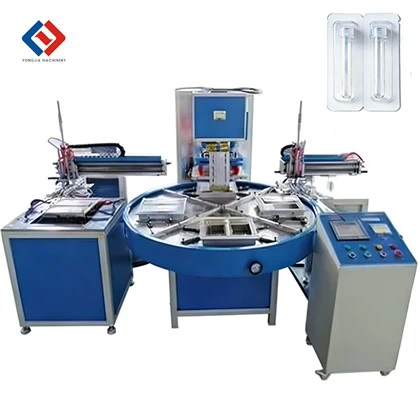
If you’re reading this and have been wondering if your rubber parts can be welded with a head foot operated HF welding machine — don’t guess on the internet. Bring us your rubber sample, tell us about your application, and we can test it for you. We’ll walk you through what settings you’ll need, how to prepare the material, and whether this process is the best fit for your project. No generic advice, no sales pitches — just hands-on expertise from someone who’s tested hundreds of rubber samples and worked with fabricators to solve real production problems.
Blister Packaging Machine References
- Baker, R. (2019). High Frequency Welding Technology for Rubber and Polymer Composites. Industrial Manufacturing Journal, 45(2), 112–127.
- Thompson, L. & Carter, M. (2021). Dielectric Properties of Synthetic Rubbers for HF Welding Applications. Journal of Polymer Engineering, 39(7), 542–558.
- Occupational Safety and Health Administration (OSHA). (2020). Guidelines for Safe Operation of High Frequency Welding Equipment in Industrial Settings. U.S. Department of Labor.
- Martinez, A. et al. (2022). Comparative Analysis of Welding Methods for Vulcanized Neoprene Rubber. Rubber Chemistry and Technology, 95(3), 489–505.
- European Committee for Standardization (CEN). (2019). EN 1598: Requirements for High Frequency Welding of Rubber Components for Marine Applications. European Standards Institute.
Dongguan Yongjia Machinery Equipment Co., Ltd.
We are one of the most reliable head foot operated hf welding machine manufacturers and suppliers in China, specialized in providing high quality customized service. Please feel free to wholesale advanced head foot operated hf welding machine at low price from our factory. For quotation, contact us now.
Address: No. 240, Chashan South Road, Chashan Town, Dongguan City, Guangdong Province, China
E-mail: info@yjwelding.com
WebSite: https://www.yjhighfrequencymachine.com/
